

Gym Divider Curtains: How to Choose the Right Style for Your Facility
Walk into almost any school gym on a weekday afternoon and you’ll see the same problem. The volleyball team wants the floor. So does the PE class, the youth basketball league, and the club that booked it two weeks ago. A gymnasium is one of the most valuable spaces in any building, and it’s rarely big enough for everyone who needs it at once.
That’s exactly what a divider curtain solves. Drop one down the middle of the floor and one gym becomes two, or three, or four. Raise it back up and you’ve got the full court again for game night. It’s one of the simplest ways to get more out of a space you already have, but the right curtain for your facility depends on your ceiling, your layout, and how often the room changes over. Here’s what to know before you choose one.
What Is a Gym Divider Curtain?

A gym divider curtain is a barrier that hangs from the ceiling and splits one large space into smaller ones. The recommended configuration is a solid vinyl section along the bottom with mesh above it. If your space calls for something different, curtains can also be made entirely of vinyl or entirely of mesh.
When it’s time to open the room back up, a motorized curtain lifts toward the ceiling at the turn of a key. A walk-draw curtain works more like a stage curtain, sliding along an overhead track and tucking neatly against the wall. You’ll find divider curtains separating courts in school gyms, creating flexible space in recreation centers, and keeping running tracks apart from the courts inside field houses. Walk-draw curtains are useful well beyond athletics, too, in cafeterias, meeting rooms, and auditoriums.
Types of Gym Divider Curtains
The biggest difference between curtain styles comes down to one thing: what happens when the curtain goes up. How a curtain stores overhead determines how much clear height you keep for play, how close it can sit to walls and bleachers, and what kind of ceiling it can hang from.
- Fold-up curtains (FC-680): A versatile, heavy-duty option for area separation. Hoist cables lift the curtain from the bottom so it folds up accordion style toward the ceiling. That fold is easy on the fabric over years of use, and it stores compactly to keep as much clear height as possible.
- Roll-up curtains (RC-690): Instead of folding, this curtain rolls itself up around its bottom pipe as heavy-duty straps lift it. It comes standard with a heavier 22 oz vinyl on the lower section.
- Top roll curtains (TC-701): This one skips cables and straps entirely and rolls up onto a pipe at the top, like a window shade. Its slim motor lets the curtain sit as close as 18 inches from the wall on the motor end, which makes it a good choice for tight gyms and spaces with bleachers.
- Center drive curtains (CDC-800): The top and bottom panels both roll toward the middle, wrapping into a compact tube that stays out of the way. It runs on a Somfy motor built right into the tube, and you can have your logo printed directly on the vinyl.
- Slope fold curtains (SC-685): Not every gym has a flat ceiling. The slope fold is designed to follow the angle of a sloped roof, folding up to one side so you keep maximum clearance for play.
- Field house slope fold curtains (SC-685XL): The big brother of the slope fold, built for large field houses. It uses two synchronized winches and is custom designed around each building.
- Perimeter curtains (FC-680P): Made to follow the inside or outside edge of a running track, so runners and the basketball or volleyball games inside can share the building without getting in each other’s way. It can even curve around the track’s turns.
- Walk-draw curtains (WC-660 and WC-660BP): The budget-friendly, no-power option. You simply pull it along an overhead aluminum track, and it stores against the wall with a hook and loop strap. The bi-parting version can be stored against either wall.
Vinyl vs. Mesh: Choosing Your Curtain Material

Think of the two sections as having different jobs. The solid vinyl at the bottom is the barrier at floor level, where the action happens. The mesh above it finishes the divider all the way to the ceiling.
On most Jaypro curtains, that means 18 oz vinyl on the bottom and 9 oz mesh up top. The RC-690 roll-up steps up to 22 oz vinyl as standard, while the CDC-800 center drive uses 11 oz mesh and offers an optional 25 oz vinyl in select colors. On most models, both materials are washable and hold up against fading, rot, mildew, and fungus. Vinyl typically runs 8 feet high, but the height and color are up to you, so it’s easy to match your school or team colors.
Are Gym Divider Curtains Fire Rated?
They should be, and it’s one of the first things to confirm for any curtain going into an occupied building. The vinyl on Jaypro’s fold-up, roll-up, top roll, slope fold, perimeter, and walk-draw curtains meets NFPA 701, ASTM E84 Class A, and California State Fire Marshal (CSFM) Title 19 requirements, and the mesh meets NFPA 701 and CSFM Title 19. The CDC-800 center drive curtain panels are also fire retardant and carry certification labels.
What to Know Before You Spec a Divider Curtain
- Whether your ceiling is flat or sloped
- Attachment height, up to 32 feet on fold-up, roll-up, and walk-draw curtains (30 feet on the TC-701)
- Curtain width, up to 120 feet on fold-up, roll-up, top roll, walk-draw, and perimeter curtains
- Clearance at the walls, with 3 feet recommended for egress
- Anything near the curtain line, like HVAC, lights, fans, and fire protection
- How you want to run it: key switch, touch controller, wireless remote, or by hand
- Vinyl height, colors, and any logo or branding
How Divider Curtains Are Operated
Running a motorized Jaypro curtain is about as simple as it gets. Each one comes standard with a key switch, and on most models, built-in limit switches stop the curtain automatically when it reaches the top or bottom. Just make sure the switch is mounted somewhere the operator can clearly see the curtain. If you’d like more control, most models can be paired with the MEC2 Master Equipment Controller, the ETEC Easy Touch Equipment Controller, or the TMX-DRX wireless remote.
One planning note: the wiring, conduit, and electrical boxes are handled by a qualified electrical contractor, so it helps to loop in your electrician early in the project. Walk-draw curtains skip all of that, since they’re moved by hand.
Plan the Curtain Around the Building
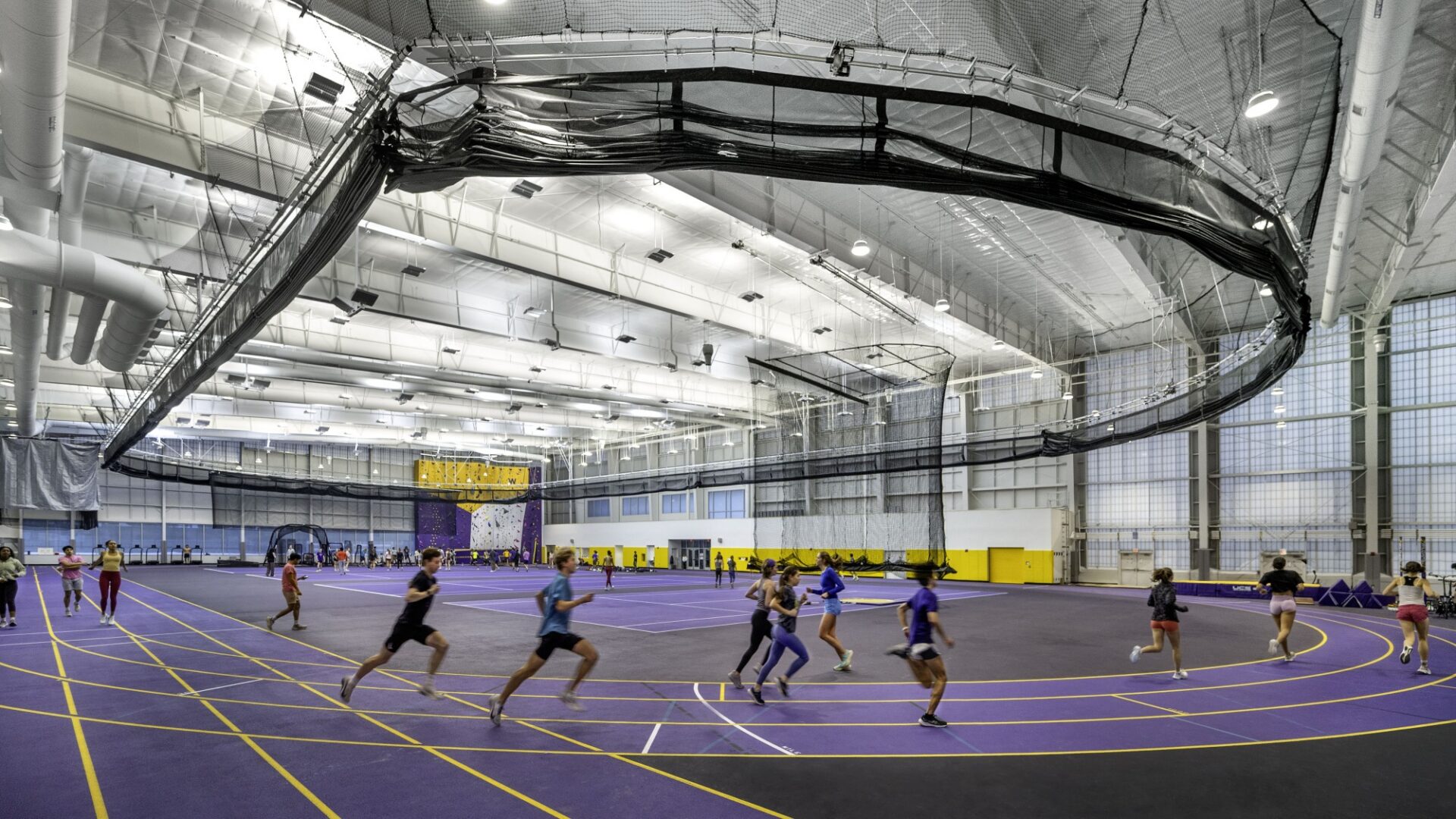
The curtains that work best are the ones planned alongside everything else in the room. Before you settle on a curtain line, make sure lights, fans, HVAC, fire protection, and structural bracing are all clear of its path. A little coordination between trades up front lets the curtain be designed for the best performance and the most clear height. Leave 3 feet at the walls for egress, and think honestly about how often the room will change over. A gym that splits for every PE period has very different needs than one that divides a few times a season.
Why Facilities Work With Jaypro

Jaypro Sports has been engineering athletic equipment and facility solutions in the United States since 1953. When it comes to divider curtains, our team supports you from the first conversation through installation, helping you pick the right style and materials, get the fit right, and coordinate the install. Every Jaypro divider curtain system is also backed by a one-year warranty against defects in material and workmanship.
Whether you’re planning a new gym or trying to squeeze more use out of the one you have, we’d be glad to help you sort through the options. Reach out at solutions@jaypro.com or 800-243-0533 to start the conversation.
Frequently Asked Questions
The main types are fold-up, roll-up, top roll, center drive, slope fold, perimeter, and walk-draw curtains. Every style except walk-draw is motorized. Slope fold curtains are made for sloped roofs, perimeter curtains follow running tracks in field houses, and walk-draw curtains slide by hand along an overhead track and store against the wall.
For most facilities, the best choice is a combination: solid vinyl on the lower section and mesh above it. Curtains are also available in all vinyl or all mesh. Vinyl typically runs 8 feet high, and you can choose both the height and the color.
Yes. The vinyl on most Jaypro divider curtains meets NFPA 701, ASTM E84 Class A, and California State Fire Marshal Title 19 requirements, and the mesh meets NFPA 701 and CSFM Title 19.
Jaypro fold-up, roll-up, top roll, walk-draw, and perimeter curtains can be up to 120 feet wide. Fold-up, roll-up, and walk-draw curtains can be mounted up to 32 feet high, and the TC-701 top roll curtain up to 30 feet. For large field houses, the SC-685XL is custom designed for each building.
Motorized Jaypro curtains come standard with a key switch, and on most models, built-in limit switches stop the curtain automatically at the top and bottom. Depending on the model, you can also add the MEC2 Master Equipment Controller, the ETEC Easy Touch Equipment Controller, or the TMX-DRX wireless remote.