

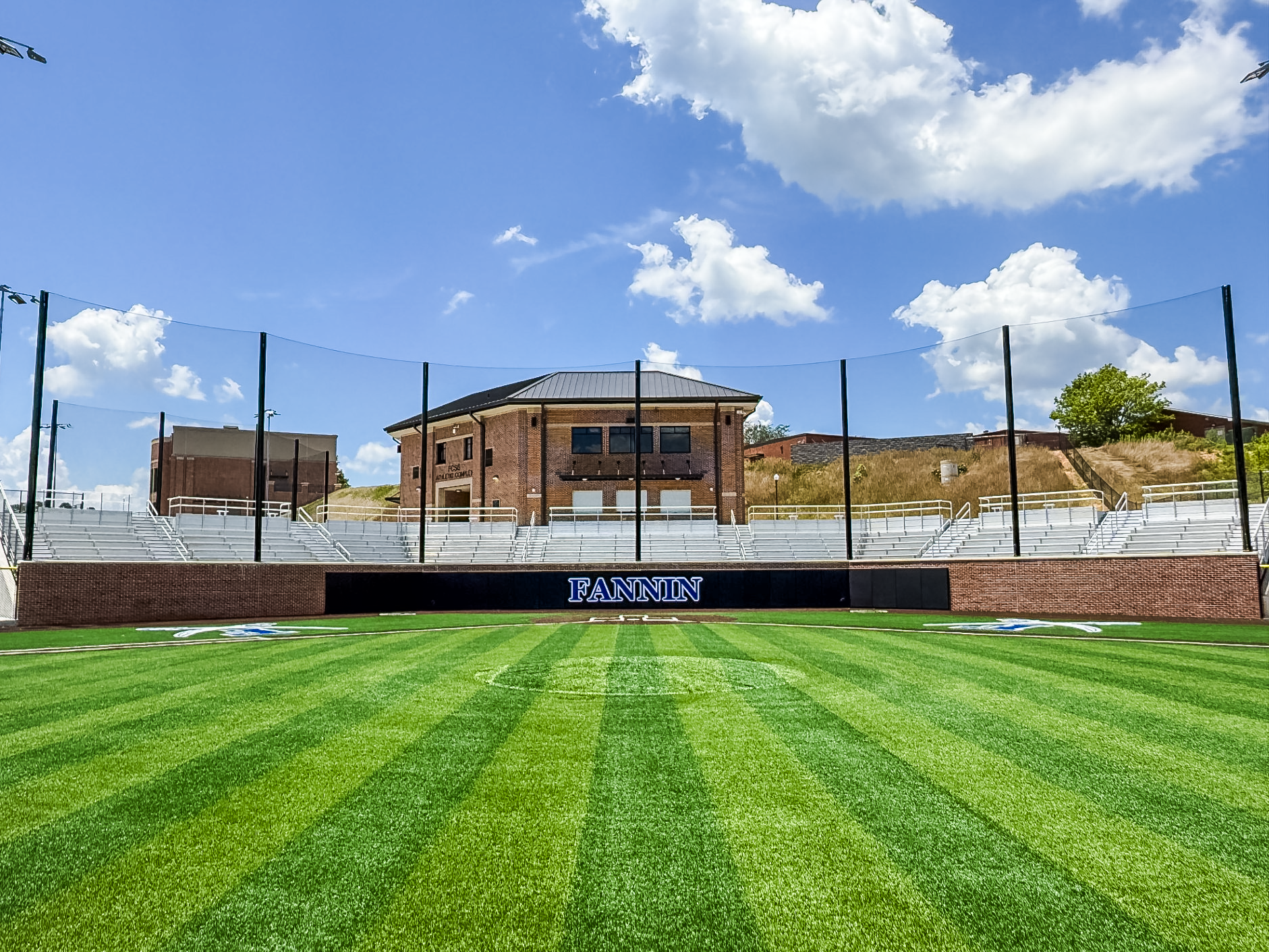
Tensioned Netting Systems for Athletic Facilities
Any facility that hosts baseball, softball, soccer, lacrosse, football, or field hockey has to answer the same question: how do you keep balls in play from reaching spectators, vehicles, buildings, and neighboring fields without turning the whole site into a fortress? For decades, the default answer was chain link fencing. Today, more architects, contractors, and facility owners are turning to tensioned netting instead, and the reasoning behind that shift is worth understanding before you spec your next project.
Why Netting Beats Traditional Chain Link
Chain link has always been practical. It defines a perimeter, controls access, and creates a hard barrier. But at a spectator-facing facility, that same rigidity works against the experience. Posts, rails, and mesh sit directly in the sightline between the stands and the field, and fans, photographers, and broadcast cameras all end up looking through a wall of metal to see the game.
Tensioned netting solves the same containment problem without the same visual cost. Because the material is thinner and less rigid than fencing, the eye tends to look past it rather than at it, so spectators stay visually connected to the action even when a net is stretched thirty or forty feet in the air behind home plate or along a sideline. The result is a facility that protects people and property just as effectively, while still feeling open.

Netting height and mesh size are set to fit the field, not the other way around.
What Actually Goes Into a Netting System
A netting system is more than the net itself. Every installation is really a combination of parts working together: mesh size, net height, pole placement, cable layout, anchoring, and the loads the system needs to withstand from wind and weather. Get any one of those wrong and the whole system underperforms, even if the net material itself is high quality.
Design decisions also depend heavily on the sport and the site. Backstop netting behind home plate on a baseball or softball field has different demands than ball-stop netting behind soccer or lacrosse goals, or divider netting used indoors to separate simultaneous practices while coaches keep visibility across the space. Poles, spacing, and hardware all need to account for nearby structures, applicable building codes, and how the netting will hold up through a full season, including whether it needs to come down during severe weather or scheduled shutdowns.
What a Netting Project Involves
- Net height, mesh size, and material selection by sport and use case
- Pole placement, spacing, and cable layout
- Anchoring and foundation design to handle anticipated loads
- Coordination with fencing, gates, bleachers, dugouts, lighting, and wind screen
- Planning for maintenance access and future field or equipment changes

Poles, cables, and anchors carry the load, the net just does the visible work.
Start With the Facility, Not the Net
The projects that hold up longest are the ones that start with a clear understanding of the facility rather than reaching for a one-size-fits-all net. That means thinking through the full picture early: how equipment gets serviced, whether the field will ever support more than one sport, and how netting integrates with everything else already on site, from fencing and gates to bleachers, dugouts, and lighting. Early coordination between designers, contractors, and the facility owner is what turns a net into a system that actually performs for years, not just a product that gets installed and hoped for.
Why Programs Work With Jaypro

A finished system built around this specific site, not a standard package.
Jaypro Sports has been engineering athletic equipment and facility solutions in the United States since 1953. Our engineering team works directly with contractors, architects, schools, parks departments, and athletic organizations to design netting systems around the specific sport, site, and safety requirements of each facility, rather than fitting a facility to a standard net.
If you’re planning a new facility or evaluating whether your current netting is doing its job, our team can walk through the design considerations with you. Reach out at OC@jaypro.com or 800-243-0533 to start the conversation.
Frequently Asked Questions
Tensioned netting provides the same containment and safety benefits as chain link fencing while preserving visibility. Because netting is less visually prominent than posts, rails, and mesh fencing, spectators, photographers, and camera operators can see through it more easily, keeping the field experience open even where a tall barrier is required.
Net height, mesh size, material, pole placement, cable layout, and anticipated loads all affect how well a netting system performs. The right specifications depend on the sport, the site, nearby structures, applicable building requirements, and whether the netting will be adjusted or removed seasonally.
Yes. Jaypro’s engineering team designs netting systems for baseball, softball, soccer, lacrosse, football, field hockey, and multipurpose facilities, working with contractors, architects, schools, and parks and recreation departments to build a system around each facility’s specific needs.